Énoncé
Le sujet porte sur la thématique « Arts et débats d'idées ».
Partie 1. Synthèse en anglais (16 points)
Prenez connaissance de la thématique ci-dessus et du dossier composé des documents A, B et C et répondez en anglais à la consigne suivante (500 mots environ) :
Paying particular attention to the characteristics of the three documents, show how they interact to explore Shakespeare's presence and heritage in today's English-speaking world.
Paying particular attention to the characteristics of the three documents, show how they interact to explore Shakespeare's presence and heritage in today's English-speaking world.
Partie 2. Traduction en français (4 points)
Traduisez en français le passage suivant du document B :
''[…] I never saw a man so eager to find out what posterity thought of him as poor Bill was. He worked hard at it.''
''You enrolled William Shakespeare in my course?'' mumbled Robertson. Even as an alcoholic fantasy, the thought staggered him. And was it an alcoholic fantasy? He was beginning to recall a bald man with a queer way of talking….
''Not under his real name, of course,'' said Dr. Welch. ''Never mind what he went under. It was a mistake, that's all. A big mistake. Poor fellow.''
''[…] I never saw a man so eager to find out what posterity thought of him as poor Bill was. He worked hard at it.''
''You enrolled William Shakespeare in my course?'' mumbled Robertson. Even as an alcoholic fantasy, the thought staggered him. And was it an alcoholic fantasy? He was beginning to recall a bald man with a queer way of talking….
''Not under his real name, of course,'' said Dr. Welch. ''Never mind what he went under. It was a mistake, that's all. A big mistake. Poor fellow.''
Document A
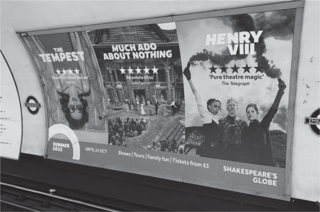 © Shakespeare's Globe theatre 2022 Summer Campaign in the London Underground. Photographer: Kate Bones |
Document B
« Dr. Phineas Welch, a drunk scientist, and Scott Robertson, a young English Professor, are having a conversation about the doctor's experiment, which made Shakespeare travel in time from the 1600s to the present day.
''Did you say you brought back Shakespeare?''
''I did. I needed someone with a universal mind; someone who knew people well enough to be able to live with them centuries way from his own time. Shakespeare was the man. I've got his signature. As a memento, you know.''
''On you?'' asked Robertson, eyes bugging.
''Right here.'' Welch fumbled in one vest pocket after another. ''Ah, here it is.''
A little piece of pasteboard was passed to the instructor. On one side it said: ''L. Klein & Sons, Wholesale Hardware.'' On the other side, in straggly script, was written, ''Will' Shakesper.''
A wild surmise filled Robertson. ''What did he look like?''
''Not like his pictures. Bald and an ugly mustache. He spoke in a thick brogue. Of course, I did my best to please him with our times. I told him we thought highly of his plays and still put them on the boards. In fact, I said we thought they were the greatest pieces of literature in the English language, maybe in any language.''
''Good. Good,'' said Robertson breathlessly.
''I said people had written volumes of commentaries on his plays. Naturally he wanted to see one and I got one for him from the library.''
''And?''
''Oh, he was fascinated. Of course, he had trouble with the current idioms and references to events since 1600, but I helped out. Poor fellow. I don't think he ever expected such treatment. He kept saying, 'God ha' mercy! What cannot be racked from words in five centuries? One could wring, methinks, a flood from a damp clout!'''(1)
''He wouldn't say that.''
''Why not? He wrote his plays as quickly as he could. He said he had to on account of the deadlines. He wrote Hamlet in less than six months. The plot was an old one. He just polished it up.''
''That's all they do to a telescope mirror. Just polish it up,'' said the English instructor indignantly.
The physicist disregarded him. He made out an untouched cocktail on the bar some feet away and sidled toward it. ''I told the immortal bard(2) that we even gave college courses in Shakespeare.''
''I give one.''
''I know. I enrolled him in your evening extension course. I never saw a man so eager to find out what posterity thought of him as poor Bill(3) was. He worked hard at it.''
''You enrolled William Shakespeare in my course?'' mumbled Robertson. Even as an alcoholic fantasy, the thought staggered him. And was it an alcoholic fantasy? He was beginning to recall a bald man with a queer way of talking…
''Not under his real name, of course,'' said Dr. Welch. ''Never mind what he went under. It was a mistake, that's all. A big mistake. Poor fellow.'' He had the cocktail now and shook his head at it.
''Why was it a mistake? What happened?'' […]
Dr. Welch tossed off the cocktail. ''Why, you poor simpleton, you flunked him.'' »
''Did you say you brought back Shakespeare?''
''I did. I needed someone with a universal mind; someone who knew people well enough to be able to live with them centuries way from his own time. Shakespeare was the man. I've got his signature. As a memento, you know.''
''On you?'' asked Robertson, eyes bugging.
''Right here.'' Welch fumbled in one vest pocket after another. ''Ah, here it is.''
A little piece of pasteboard was passed to the instructor. On one side it said: ''L. Klein & Sons, Wholesale Hardware.'' On the other side, in straggly script, was written, ''Will' Shakesper.''
A wild surmise filled Robertson. ''What did he look like?''
''Not like his pictures. Bald and an ugly mustache. He spoke in a thick brogue. Of course, I did my best to please him with our times. I told him we thought highly of his plays and still put them on the boards. In fact, I said we thought they were the greatest pieces of literature in the English language, maybe in any language.''
''Good. Good,'' said Robertson breathlessly.
''I said people had written volumes of commentaries on his plays. Naturally he wanted to see one and I got one for him from the library.''
''And?''
''Oh, he was fascinated. Of course, he had trouble with the current idioms and references to events since 1600, but I helped out. Poor fellow. I don't think he ever expected such treatment. He kept saying, 'God ha' mercy! What cannot be racked from words in five centuries? One could wring, methinks, a flood from a damp clout!'''(1)
''He wouldn't say that.''
''Why not? He wrote his plays as quickly as he could. He said he had to on account of the deadlines. He wrote Hamlet in less than six months. The plot was an old one. He just polished it up.''
''That's all they do to a telescope mirror. Just polish it up,'' said the English instructor indignantly.
The physicist disregarded him. He made out an untouched cocktail on the bar some feet away and sidled toward it. ''I told the immortal bard(2) that we even gave college courses in Shakespeare.''
''I give one.''
''I know. I enrolled him in your evening extension course. I never saw a man so eager to find out what posterity thought of him as poor Bill(3) was. He worked hard at it.''
''You enrolled William Shakespeare in my course?'' mumbled Robertson. Even as an alcoholic fantasy, the thought staggered him. And was it an alcoholic fantasy? He was beginning to recall a bald man with a queer way of talking…
''Not under his real name, of course,'' said Dr. Welch. ''Never mind what he went under. It was a mistake, that's all. A big mistake. Poor fellow.'' He had the cocktail now and shook his head at it.
''Why was it a mistake? What happened?'' […]
Dr. Welch tossed off the cocktail. ''Why, you poor simpleton, you flunked him.'' »
Isaac ASIMOV, ''The Immortal Bard'', Universe Science Fiction, 1954
Document C
Shakespeare: How do I compare thee(4) to hip-hop?« In a community hall in Hoxton, London, a small piece of alchemy is taking place. A group of teenagers who only minutes before were fidgeting with their mobile phones, are up on stage reciting one of Shakespeare's best known sonnets in rap. […]
Mobo(5) award-winning rapper Akala […] is running a series of workshops that tease out the links between hip-hop and Shakespeare. But why? ''I actually did a song called Shakespeare three or four years ago,'' says Akala, ''It was a comedic parody that I was the rapping reincarnation of Shakespeare. Not that I am, but there is a genuine relationship between poetry of all forms and that song made me ask – if Shakespeare was alive today, would he have been a rapper?'' […]
The nine teenagers at today's workshop aren't here because of their love for the Bard. In a Q&A(6) session, only two of them say they'd have come if today hadn't involved rapping. That begins to change when Akala engages them in a series of exercises that explore the close relationship between the rhythms of modern hip-hop and the iambic pentameter of Shakespeare. He hands out cards printed with a couple of lines. We have to decide whether they're the work of the playwright or a rapper. It's harder than you'd think. The kids are adamant that certain words and phrases are those of a rapper, but they're actually from Shakespeare. And vice versa. It's a hook, and it's only half an hour later that they're translating Sonnet 18 into hip-hop verse.
Some of the kids tell me that they hate how Shakespeare is taught at school – how boring the approach is. But will this send them scuttling back to Othello with a fresh eye? Akala says the aim isn't that limited: ''It's about showing them what's attainable. And if Shakespeare is presented as the most unattainable, highbrow entity, but then it's made relevant to them, what else might be?'' »
Mobo(5) award-winning rapper Akala […] is running a series of workshops that tease out the links between hip-hop and Shakespeare. But why? ''I actually did a song called Shakespeare three or four years ago,'' says Akala, ''It was a comedic parody that I was the rapping reincarnation of Shakespeare. Not that I am, but there is a genuine relationship between poetry of all forms and that song made me ask – if Shakespeare was alive today, would he have been a rapper?'' […]
The nine teenagers at today's workshop aren't here because of their love for the Bard. In a Q&A(6) session, only two of them say they'd have come if today hadn't involved rapping. That begins to change when Akala engages them in a series of exercises that explore the close relationship between the rhythms of modern hip-hop and the iambic pentameter of Shakespeare. He hands out cards printed with a couple of lines. We have to decide whether they're the work of the playwright or a rapper. It's harder than you'd think. The kids are adamant that certain words and phrases are those of a rapper, but they're actually from Shakespeare. And vice versa. It's a hook, and it's only half an hour later that they're translating Sonnet 18 into hip-hop verse.
Some of the kids tell me that they hate how Shakespeare is taught at school – how boring the approach is. But will this send them scuttling back to Othello with a fresh eye? Akala says the aim isn't that limited: ''It's about showing them what's attainable. And if Shakespeare is presented as the most unattainable, highbrow entity, but then it's made relevant to them, what else might be?'' »
Andrew EMERY, The Guardian, April 2009
Corrigé
Partie 1. Synthèse en anglais (16 points)
Method
Start by identifying the common issue linking the three documents. Rather than analysing each source separately, organise your synthesis around two or three main ideas and constantly establish connections between the documents. Your conclusion should answer the question raised in your introduction.Suggested outline
How do the documents show that Shakespeare's works remain relevant today?
I. Shakespeare's works have become a lasting cultural heritage.
II. They continue to inspire new interpretations and artistic creations.
The three documents illustrate the enduring influence of William Shakespeare and demonstrate how his works continue to inspire readers, audiences and artists centuries after they were written. Together, they show that Shakespeare's legacy is constantly renewed through education, performance and modern reinterpretations.
First of all, the documents highlight Shakespeare's place in British and international culture. The London Underground poster advertises three plays currently performed at the Globe Theatre, reminding us that Shakespeare's works are still regularly staged for contemporary audiences. Although written over four hundred years ago, these plays remain an essential part of cultural life.
Document B adopts a more imaginative approach. In Isaac Asimov's short story, Shakespeare is unexpectedly transported into the twentieth century and discovers that his works are now studied in schools and universities. This humorous situation underlines the playwright's exceptional reputation while also suggesting that literary works can be interpreted in many different ways. The gap between Shakespeare's original intentions and modern criticism encourages readers to reflect on the evolving nature of literature.
Finally, the newspaper article demonstrates that Shakespeare continues to inspire contemporary artists. By comparing the rhythm of his poetry with hip-hop music, the article shows that his language and themes can still appeal to younger generations. Rather than preserving his works unchanged, modern artists adapt them to new cultural contexts while maintaining their emotional and poetic power.
Taken together, the documents show that Shakespeare is far more than a historical figure. His plays and poems continue to generate discussion, creativity and new interpretations, proving that great literature remains meaningful across different periods and cultures.
First of all, the documents highlight Shakespeare's place in British and international culture. The London Underground poster advertises three plays currently performed at the Globe Theatre, reminding us that Shakespeare's works are still regularly staged for contemporary audiences. Although written over four hundred years ago, these plays remain an essential part of cultural life.
Document B adopts a more imaginative approach. In Isaac Asimov's short story, Shakespeare is unexpectedly transported into the twentieth century and discovers that his works are now studied in schools and universities. This humorous situation underlines the playwright's exceptional reputation while also suggesting that literary works can be interpreted in many different ways. The gap between Shakespeare's original intentions and modern criticism encourages readers to reflect on the evolving nature of literature.
Finally, the newspaper article demonstrates that Shakespeare continues to inspire contemporary artists. By comparing the rhythm of his poetry with hip-hop music, the article shows that his language and themes can still appeal to younger generations. Rather than preserving his works unchanged, modern artists adapt them to new cultural contexts while maintaining their emotional and poetic power.
Taken together, the documents show that Shakespeare is far more than a historical figure. His plays and poems continue to generate discussion, creativity and new interpretations, proving that great literature remains meaningful across different periods and cultures.
Examiner's tips
– Avoid summarising each document separately.
– Show how the documents complement one another.
– Mention both heritage and modern reinterpretation.
– Use precise vocabulary (legacy, adaptation, performance, reinterpretation, audience).
– Avoid summarising each document separately.
– Show how the documents complement one another.
– Mention both heritage and modern reinterpretation.
– Use precise vocabulary (legacy, adaptation, performance, reinterpretation, audience).
Partie 2. Traduction en français (4 points)
Main translation difficulties
Before translating, identify the main grammatical and lexical challenges.– Posterity refers to future generations or la postérité, not simply the future.
– Eager to means désireux de, impatient de, avide de.
– Staggered is used figuratively here: to astonish, to overwhelm, not faire trébucher.
– Queer means strange, unusual in this context (not its more recent meaning referring to sexual identity).
– Went under means used as a name or went by, not went underneath.
– The dialogue should remain natural and fluid in French.
« Je n'ai jamais connu d'homme aussi désireux de savoir ce que la postérité penserait de lui que ce pauvre Bill. Il y consacrait beaucoup d'énergie.
— Vous avez inscrit William Shakespeare à mon cours ? » marmonna Robertson. Même comme hallucination d'un homme ivre, cette idée le bouleversait. Et d'ailleurs, en était-ce vraiment une ? Il commençait à se souvenir d'un homme chauve qui s'exprimait d'une façon plutôt étrange…
« Pas sous son véritable nom, bien sûr, répondit le docteur Welch. Peu importe le nom qu'il utilisait. C'était simplement une erreur. Une grosse erreur. Le pauvre. »
— Vous avez inscrit William Shakespeare à mon cours ? » marmonna Robertson. Même comme hallucination d'un homme ivre, cette idée le bouleversait. Et d'ailleurs, en était-ce vraiment une ? Il commençait à se souvenir d'un homme chauve qui s'exprimait d'une façon plutôt étrange…
« Pas sous son véritable nom, bien sûr, répondit le docteur Welch. Peu importe le nom qu'il utilisait. C'était simplement une erreur. Une grosse erreur. Le pauvre. »