Énoncé
Le sujet porte sur la thématique « Voyages, territoires, frontières ».
Partie 1. Synthèse en anglais (16 points)
Prenez connaissance de la thématique ci-dessus et du dossier composé des documents A, B et C et répondez en anglais à la consigne suivante (500 mots environ) :Paying particular attention to the characteristics of the three documents, show how they interact to illustrate the encounter between two worlds.
Partie 2. Traduction en français (4 points)
Traduisez en français le passage suivant du document A :
I've written nothing in this record for many days. So much has happened that I hardly know where to begin.
The Indians have come to visit on three occasions thus far and I have no doubt there will be more. Always the same two with their escort of six or seven other warriors. (I am amazed that all these people are warriors. Have not seen a man yet who is not a fighter.)
Our meetings have been highly amicable, though greatly hampered by the language barrier.
I've written nothing in this record for many days. So much has happened that I hardly know where to begin.
The Indians have come to visit on three occasions thus far and I have no doubt there will be more. Always the same two with their escort of six or seven other warriors. (I am amazed that all these people are warriors. Have not seen a man yet who is not a fighter.)
Our meetings have been highly amicable, though greatly hampered by the language barrier.
Document A
« Lieutenant Dunbar travels to the American Frontier to reorganize a deserted military camp.
May 17, 1863
I've written nothing in this record for many days. So much has happened that I hardly know where to begin.
The Indians have come to visit on three occasions thus far and I have no doubt there will be more. Always the same two with their escort of six or seven other warriors. (I am amazed that all these people are warriors. Have not seen a man yet who is not a fighter.)
Our meetings have been highly amicable, though greatly hampered by the language barrier. Whatever I have learned to date is so little compared to what I could know. I still don't know what type of Indians they are but suspect them to be Comanche. I believe I have heard a word that sounds like Comanche more than once. […]
We converse in made-up signs, a sort of pantomime which both Indians are starting to get the hang of. But it is very slow going, and most of our common ground has been established on the basis of failure rather than success in communication.
The fierce one dumps extraordinary amounts of sugar into his coffee. It won't be long before that ration is exhausted. Luckily, I do not take sugar. Ha! The fierce one (as I call him) is likable despite his taciturn manner, rather like a king of street toughs who, by virtue of his physical prowess, commands respect. Having spent some time on the streets myself, I respect him in this way.
Beyond that, there is a crude honesty and intent which I like.
He is a direct fellow.
I call the other man the quiet one and like him immensely. Unlike the fierce one, he is patient and inquisitive.
I think he is as frustrated as I with the language difficulties. He has taught me a few words of their speech, and I have done the same for him. I know the Comanche words for head, hand, horse, fire, coffee, house, and several others, as well as hello and good-bye. I don't know enough yet to make a sentence. It takes a long time to get the sounds right. I have no doubt it is hard for him as well.
The quiet one calls me Loo Ten Nant(1) and for some reason does not use Dunbar. I am sure he doesn't forget to use it (I have reminded him several times), so there must be another reason. It certainly has a distinctive ring… Loo Ten Nant.
He strikes me as being possessed of a first-rate intelligence. He listens with care and seems to notice everything. […] Without language I am reduced to reading his reactions with my senses, but by all appearances he is favorably inclined toward me. »
May 17, 1863
I've written nothing in this record for many days. So much has happened that I hardly know where to begin.
The Indians have come to visit on three occasions thus far and I have no doubt there will be more. Always the same two with their escort of six or seven other warriors. (I am amazed that all these people are warriors. Have not seen a man yet who is not a fighter.)
Our meetings have been highly amicable, though greatly hampered by the language barrier. Whatever I have learned to date is so little compared to what I could know. I still don't know what type of Indians they are but suspect them to be Comanche. I believe I have heard a word that sounds like Comanche more than once. […]
We converse in made-up signs, a sort of pantomime which both Indians are starting to get the hang of. But it is very slow going, and most of our common ground has been established on the basis of failure rather than success in communication.
The fierce one dumps extraordinary amounts of sugar into his coffee. It won't be long before that ration is exhausted. Luckily, I do not take sugar. Ha! The fierce one (as I call him) is likable despite his taciturn manner, rather like a king of street toughs who, by virtue of his physical prowess, commands respect. Having spent some time on the streets myself, I respect him in this way.
Beyond that, there is a crude honesty and intent which I like.
He is a direct fellow.
I call the other man the quiet one and like him immensely. Unlike the fierce one, he is patient and inquisitive.
I think he is as frustrated as I with the language difficulties. He has taught me a few words of their speech, and I have done the same for him. I know the Comanche words for head, hand, horse, fire, coffee, house, and several others, as well as hello and good-bye. I don't know enough yet to make a sentence. It takes a long time to get the sounds right. I have no doubt it is hard for him as well.
The quiet one calls me Loo Ten Nant(1) and for some reason does not use Dunbar. I am sure he doesn't forget to use it (I have reminded him several times), so there must be another reason. It certainly has a distinctive ring… Loo Ten Nant.
He strikes me as being possessed of a first-rate intelligence. He listens with care and seems to notice everything. […] Without language I am reduced to reading his reactions with my senses, but by all appearances he is favorably inclined toward me. »
Michael BLAKE, Dances with Wolves, 1986
Document B
« Jim Burden, the young narrator, arrives in Nebraska, USA, for the first time and meets Ántonia Shimerda, her parents, her younger sister Yulka, and Krajiek, their neighbor.
As we approached the Shimerdas' dwelling, I could still see nothing but rough red hillocks, and draws(2) with shelving banks and long roots hanging out where the earth had crumbled away. Presently, against one of those banks, I saw a sort of shed […]. The door stood open, and a woman and a girl of fourteen ran out and looked up at us hopefully. A little girl trailed along behind them. The woman had on her head the same embroidered shawl with silk fringes that she wore when she had alighted from the train at Black Hawk. She was not old, but she was certainly not young. Her face was alert and lively, with a sharp chin and shrewd little eyes. She shook grandmother's hand energetically. ''Very glad, very glad!'' she ejaculated. Immediately she pointed to the bank out of which she had emerged and said, ''House no good, house no good!''
Grandmother nodded consolingly. ''You'll get fixed up comfortable after while, Mrs. Shimerda; make good house.''
My grandmother always spoke in a very loud tone to foreigners, as if they were deaf. She made Mrs. Shimerda understand the friendly intention of our visit, and the Bohemian(3) woman handled the loaves of bread and even smelled them, and examined the pies with lively curiosity, exclaiming, ''Much good, much thank!'' — and again she wrung grandmother's hand. […]
While Krajiek was translating for Mr. Shimerda, Ántonia came up to me and held out her hand coaxingly. In a moment we were running up the steep draw-side together, Yulka trotting after us.
When we reached the level and could see the gold tree-tops, I pointed toward them, and Ántonia laughed and squeezed my hand as if to tell me how glad she was I had come. We raced off toward Squaw Creek and did not stop until the ground itself stopped — fell away before us so abruptly that the next step would have been out into the tree-tops. We stood panting on the edge of the ravine, looking down at the trees and bushes that grew below us. The wind was so strong that I had to hold my hat on, and the girls' skirts were blown out before them. Ántonia seemed to like it; she held her little sister by the hand and chattered away in that language which seemed to me spoken so much more rapidly than mine. She looked at me, her eyes fairly blazing with things she could not say.
''Name? What name?'' she asked, touching me on the shoulder. I told her my name, and she repeated it after me […]. »
As we approached the Shimerdas' dwelling, I could still see nothing but rough red hillocks, and draws(2) with shelving banks and long roots hanging out where the earth had crumbled away. Presently, against one of those banks, I saw a sort of shed […]. The door stood open, and a woman and a girl of fourteen ran out and looked up at us hopefully. A little girl trailed along behind them. The woman had on her head the same embroidered shawl with silk fringes that she wore when she had alighted from the train at Black Hawk. She was not old, but she was certainly not young. Her face was alert and lively, with a sharp chin and shrewd little eyes. She shook grandmother's hand energetically. ''Very glad, very glad!'' she ejaculated. Immediately she pointed to the bank out of which she had emerged and said, ''House no good, house no good!''
Grandmother nodded consolingly. ''You'll get fixed up comfortable after while, Mrs. Shimerda; make good house.''
My grandmother always spoke in a very loud tone to foreigners, as if they were deaf. She made Mrs. Shimerda understand the friendly intention of our visit, and the Bohemian(3) woman handled the loaves of bread and even smelled them, and examined the pies with lively curiosity, exclaiming, ''Much good, much thank!'' — and again she wrung grandmother's hand. […]
While Krajiek was translating for Mr. Shimerda, Ántonia came up to me and held out her hand coaxingly. In a moment we were running up the steep draw-side together, Yulka trotting after us.
When we reached the level and could see the gold tree-tops, I pointed toward them, and Ántonia laughed and squeezed my hand as if to tell me how glad she was I had come. We raced off toward Squaw Creek and did not stop until the ground itself stopped — fell away before us so abruptly that the next step would have been out into the tree-tops. We stood panting on the edge of the ravine, looking down at the trees and bushes that grew below us. The wind was so strong that I had to hold my hat on, and the girls' skirts were blown out before them. Ántonia seemed to like it; she held her little sister by the hand and chattered away in that language which seemed to me spoken so much more rapidly than mine. She looked at me, her eyes fairly blazing with things she could not say.
''Name? What name?'' she asked, touching me on the shoulder. I told her my name, and she repeated it after me […]. »
Willa CATHER, My Ántonia, 1918
Document C
Note: The scene takes place in 1901. The boy has just arrived on Ellis Island, an immigrant center located in New York Harbor.
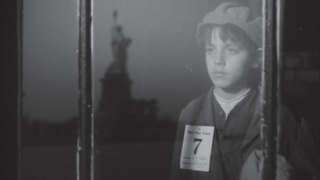 Francis Ford COPPOLA (film director), The Godfather: Part II, 1974 (still from the movie), © Paramount Pictures. |
Corrigé
Partie 1. Synthèse en anglais (16 points)
Method
Before writing your synthesis, identify the common topic shared by the three documents. Analyse each source separately before comparing them. Your synthesis should not describe the documents one after another but organise ideas around a clear argument supported by examples from every document.Suggested outline
How do the documents portray migration as both a challenge and an opportunity?
I. Crossing borders means discovering unfamiliar people, languages and cultures.
II. Adapting to a new environment transforms both individuals and societies.
The three documents explore the experience of crossing geographical and cultural borders in American history. Whether through westward expansion, European immigration or the discovery of a new homeland, they illustrate both the difficulties and the opportunities created by encounters with unfamiliar people and places.
To begin with, each document presents migration as an encounter with the unknown. In Dances with Wolves, Lieutenant Dunbar meets a Native American tribe during the Civil War. Because he cannot speak their language, communication initially depends on gestures, illustrating the barriers that separate different cultures. However, curiosity gradually replaces fear, allowing mutual understanding to develop.
Similarly, My Ántonia focuses on immigration from Europe to the United States. The narrator meets a Bohemian family who must adapt to a completely new country while overcoming linguistic and cultural differences. Their arrival highlights the diversity created by successive waves of immigration and the challenges faced by newcomers.
The film still from The Godfather Part II also represents the beginning of a journey. The young boy arriving at Ellis Island symbolises millions of immigrants hoping for a better future in America. His gaze towards the Statue of Liberty reflects both hope and uncertainty as he prepares to enter an unfamiliar world.
Beyond the first encounter, the documents also emphasise adaptation. Dunbar progressively discovers Native American customs and learns that cultural differences should not lead to prejudice. Likewise, the immigrants in My Ántonia gradually build a new life despite the difficulties of the American frontier. Finally, the image from The Godfather Part II reminds us that entering a new country is only the first step towards integration into a new society.
Taken together, the documents show that crossing borders is much more than a physical journey. It is a personal transformation that challenges identities while contributing to the cultural richness of the United States.
To begin with, each document presents migration as an encounter with the unknown. In Dances with Wolves, Lieutenant Dunbar meets a Native American tribe during the Civil War. Because he cannot speak their language, communication initially depends on gestures, illustrating the barriers that separate different cultures. However, curiosity gradually replaces fear, allowing mutual understanding to develop.
Similarly, My Ántonia focuses on immigration from Europe to the United States. The narrator meets a Bohemian family who must adapt to a completely new country while overcoming linguistic and cultural differences. Their arrival highlights the diversity created by successive waves of immigration and the challenges faced by newcomers.
The film still from The Godfather Part II also represents the beginning of a journey. The young boy arriving at Ellis Island symbolises millions of immigrants hoping for a better future in America. His gaze towards the Statue of Liberty reflects both hope and uncertainty as he prepares to enter an unfamiliar world.
Beyond the first encounter, the documents also emphasise adaptation. Dunbar progressively discovers Native American customs and learns that cultural differences should not lead to prejudice. Likewise, the immigrants in My Ántonia gradually build a new life despite the difficulties of the American frontier. Finally, the image from The Godfather Part II reminds us that entering a new country is only the first step towards integration into a new society.
Taken together, the documents show that crossing borders is much more than a physical journey. It is a personal transformation that challenges identities while contributing to the cultural richness of the United States.
Examiner's tips
– Organise your synthesis around ideas, not documents.
– Link the three sources throughout your answer.
– Use connectors such as Similarly, Likewise, In contrast, Overall.
– Avoid long quotations: brief references to the documents are sufficient.
– Organise your synthesis around ideas, not documents.
– Link the three sources throughout your answer.
– Use connectors such as Similarly, Likewise, In contrast, Overall.
– Avoid long quotations: brief references to the documents are sufficient.
Partie 2. Traduction en français (4 points)
Main translation difficulties
Before translating, identify the main grammatical and lexical challenges.
– Present perfect: I've written nothing… → exprime une action commencée dans le passé ayant un lien avec le présent.
– Thus far = jusqu'à présent.
– Escort does not mean escorte in the French military sense, but rather groupe accompagnant.
– Warrior should be translated as guerrier, not soldat.
– Hampered by means entravé par, gêné par.
– Be careful with the narrator's style: the diary uses short, direct sentences, which should be preserved in French.
Before translating, identify the main grammatical and lexical challenges.
– Present perfect: I've written nothing… → exprime une action commencée dans le passé ayant un lien avec le présent.
– Thus far = jusqu'à présent.
– Escort does not mean escorte in the French military sense, but rather groupe accompagnant.
– Warrior should be translated as guerrier, not soldat.
– Hampered by means entravé par, gêné par.
– Be careful with the narrator's style: the diary uses short, direct sentences, which should be preserved in French.
Je n'ai rien écrit dans ce journal depuis plusieurs jours. Il s'est passé tant de choses que je ne sais pas vraiment par où commencer.
Les Indiens sont venus nous rendre visite à trois reprises jusqu'à présent et je ne doute pas qu'ils reviendront encore. Ce sont toujours les deux mêmes, accompagnés de six ou sept autres guerriers. Je suis étonné de constater que tous ces hommes sont des guerriers. Jusqu'à présent, je n'ai pas encore vu un seul homme qui ne soit pas un combattant.
Nos rencontres ont toujours été très cordiales, bien qu'elles aient été fortement entravées par la barrière de la langue.
Les Indiens sont venus nous rendre visite à trois reprises jusqu'à présent et je ne doute pas qu'ils reviendront encore. Ce sont toujours les deux mêmes, accompagnés de six ou sept autres guerriers. Je suis étonné de constater que tous ces hommes sont des guerriers. Jusqu'à présent, je n'ai pas encore vu un seul homme qui ne soit pas un combattant.
Nos rencontres ont toujours été très cordiales, bien qu'elles aient été fortement entravées par la barrière de la langue.